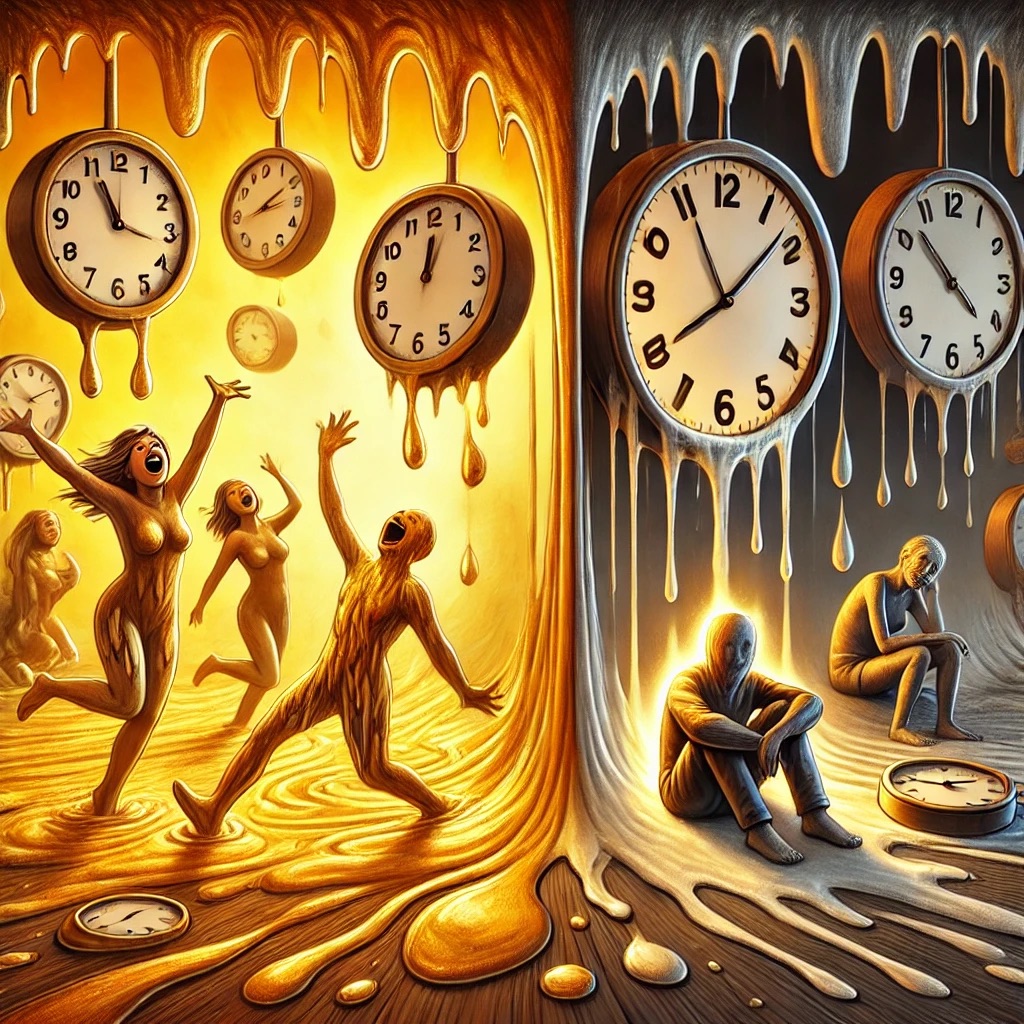
Time is supposed to be constant. A second is a second. A minute is a minute. And yet, it never truly feels that way.
When we’re lost in conversation, when laughter fills the air, when everything around us dissolves into the warmth of a moment—we blink, and it’s gone. Hours feel like minutes, slipping through our grasp before we even realize they were there.
But in contrast, when we’re forced to endure something unbearable—waiting in a line that never moves, sitting through a conversation that drains us, enduring pain, discomfort, or boredom—time stretches, warping into something agonizingly slow. Seconds drag. Minutes feel like an eternity.
Why?
Is it perception? The way our minds process joy versus discomfort? Or is it something deeper—an inherent imbalance in the way we experience reality?
Perhaps time isn’t slipping away in moments of happiness. Perhaps, in those fleeting instances, we are simply present. We exist so fully in the now that time ceases to matter, making it feel like it disappears.
And maybe suffering does the opposite. It forces us to look at time. To measure it. To count every agonizing second because we want it to be over. And in doing so, we stretch it.
But what if we could trick time? What if, even in discomfort, we could detach from the weight of it—sink into the moment rather than fight against it? Would it pass more quickly then? Or is time an illusion that only exists when we pay attention to it?
Maybe time isn’t something that moves around us. Maybe we are the ones who move through it—sometimes floating, sometimes drowning, always searching for the right current to carry us forward.
 Burning Beneath
Leave a comment