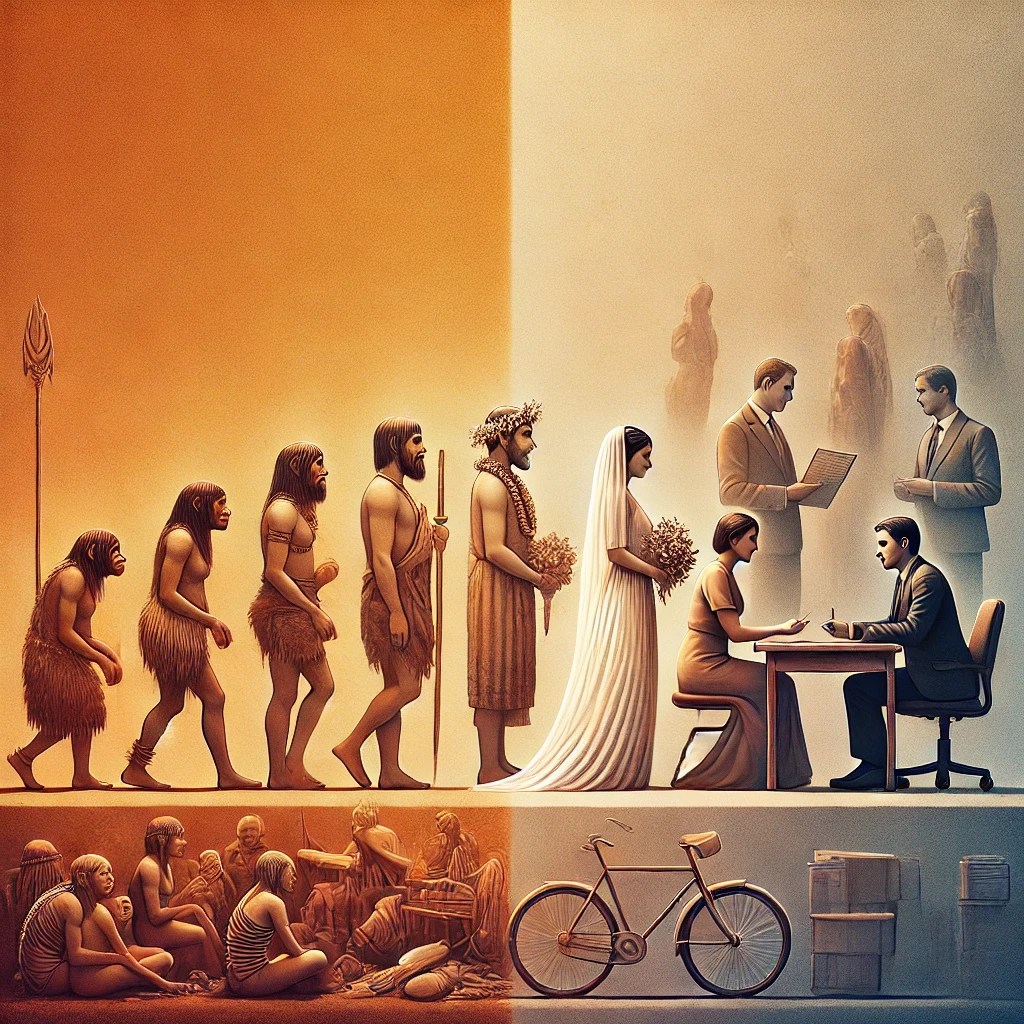
Lately, I’ve found myself reflecting on the concept of marriage. Not on the endless debates about who should marry whom, but on the more fundamental questions: What is marriage? Where did it come from? And, perhaps most importantly, does it still hold meaning in our modern world?
As I sifted through history, religion, and modern legalities, I discovered that the idea of marriage is anything but simple. It’s a concept deeply intertwined with human culture, shaped by time, power, religion, and necessity. Yet, beneath all these layers lies a question that lingers: is marriage still essential?
To understand marriage, we first have to look at what existed before it. Anthropologists believe that in early human societies, partnerships and family structures were far more fluid. Tribes and clans were the primary social units, and sexual partnerships weren’t necessarily tied to long-term commitments or exclusivity. These societies relied on shared responsibilities—raising children, gathering food, and protecting the group were communal efforts rather than the responsibility of two individuals bound by a contract.
Over time, as humanity began transitioning from nomadic lifestyles to more settled agricultural communities, these arrangements changed. Property ownership became a cornerstone of survival, and with it came the need to establish clearer lines of inheritance and familial responsibility. This marked the earliest steps toward formalizing unions—a move not yet called “marriage” but one that laid the groundwork for the institution we know today.
Was marriage invented by religion? The evidence suggests that marriage predates organized religion, though religion has played a significant role in shaping its meaning and practice. The earliest recorded marriage ceremonies date back about 4,350 years to ancient Mesopotamia. These unions were less about love and more about practical concerns—property, alliances, and securing offspring. Marriage, in its infancy, was primarily a tool for organizing society.
When religion began to formalize human life, it naturally absorbed and shaped the concept of marriage. In Christianity, for example, marriage became not only a social contract but also a sacred covenant. The Bible provides several references to marriage, often framing it as a spiritual union. Ephesians 5:22–33 compares the relationship between a husband and wife to that of Christ and the Church, emphasizing devotion and unity. Similarly, the Quran highlights marriage as a sign of God’s design, as seen in Surah Ar-Rum (30:21), which describes the love and mercy between spouses as divine gifts.
Hinduism, Zoroastrianism, and other ancient religions also incorporated marriage into their practices, imbuing it with ritual and sacredness. However, while religions elevated marriage to a spiritual act, it remained deeply tied to social and economic concerns. Dowries, bride prices, and the consolidation of wealth and alliances were as much a part of the marriage ceremony as vows or blessings.
In the Middle Ages, the Christian Church became the primary arbiter of marriage in Europe, dictating who could marry and under what conditions. Prohibitions against marrying close relatives, rules about consent, and requirements for public ceremonies were established. The Church’s involvement was not merely spiritual—it also served as a means of social and moral control. Marriage ensured the legitimacy of children, preserved property rights, and reinforced societal norms.
By the 18th and 19th centuries, the concept of marrying for love began to emerge. Yet even as romance entered the picture, marriage remained a tool of governance. Women, in particular, were often treated as property, their rights subsumed by their husbands upon marriage. It wasn’t until the feminist movements of the 19th and 20th centuries that marriage laws began to shift, granting women greater autonomy and equality within the institution.
In the modern era, especially in Western countries, marriage has become more of a legal contract than a religious or spiritual covenant. Civil ceremonies often emphasize the legal rights and obligations between two individuals, such as tax benefits, inheritance rights, and spousal support. Yet, curiously, this legal framework ties not just the two individuals to each other but also binds them to the state. Marriage, in many ways, is as much a contract with the government as it is with a partner.
This raises an interesting question: why does the government need to be involved in marriage at all? Historically, state involvement ensured clear inheritance lines and family stability. But today, as relationships and family structures evolve, many argue that the government’s role in marriage feels outdated. For instance, many legal benefits associated with marriage, such as health insurance or tax breaks, could theoretically be extended to all partnerships, married or not.
This brings us to the crux of the matter: is marriage still relevant? Some argue that it provides stability, both emotionally and financially. Others view it as an outdated institution, rooted in patriarchal traditions that no longer serve modern relationships.
If two people stay together without a marriage contract, does it make their relationship any less valid? Increasingly, couples are choosing cohabitation over marriage, rejecting the idea that a legal or religious ceremony is necessary to define their commitment. At the same time, marriage remains deeply significant for many—whether for religious reasons, societal acceptance, or personal fulfillment.
Marriage, at its core, is a reflection of the society it exists within. What began as a practical arrangement has been shaped by religion, law, and culture into an institution that carries immense personal and social weight. Yet, as society continues to change, marriage must adapt—or risk losing its relevance entirely.
Perhaps the real question isn’t whether marriage should exist but what it should mean. Is it a promise of love and partnership? A legal safeguard? A spiritual covenant? Or something else entirely? These questions remind us that marriage, like any institution, is not static. It evolves with us, shaped by our values, beliefs, and needs.
For now, all we can do is examine its past, question its present, and imagine what it could become in the future
 Burning Beneath
Leave a comment